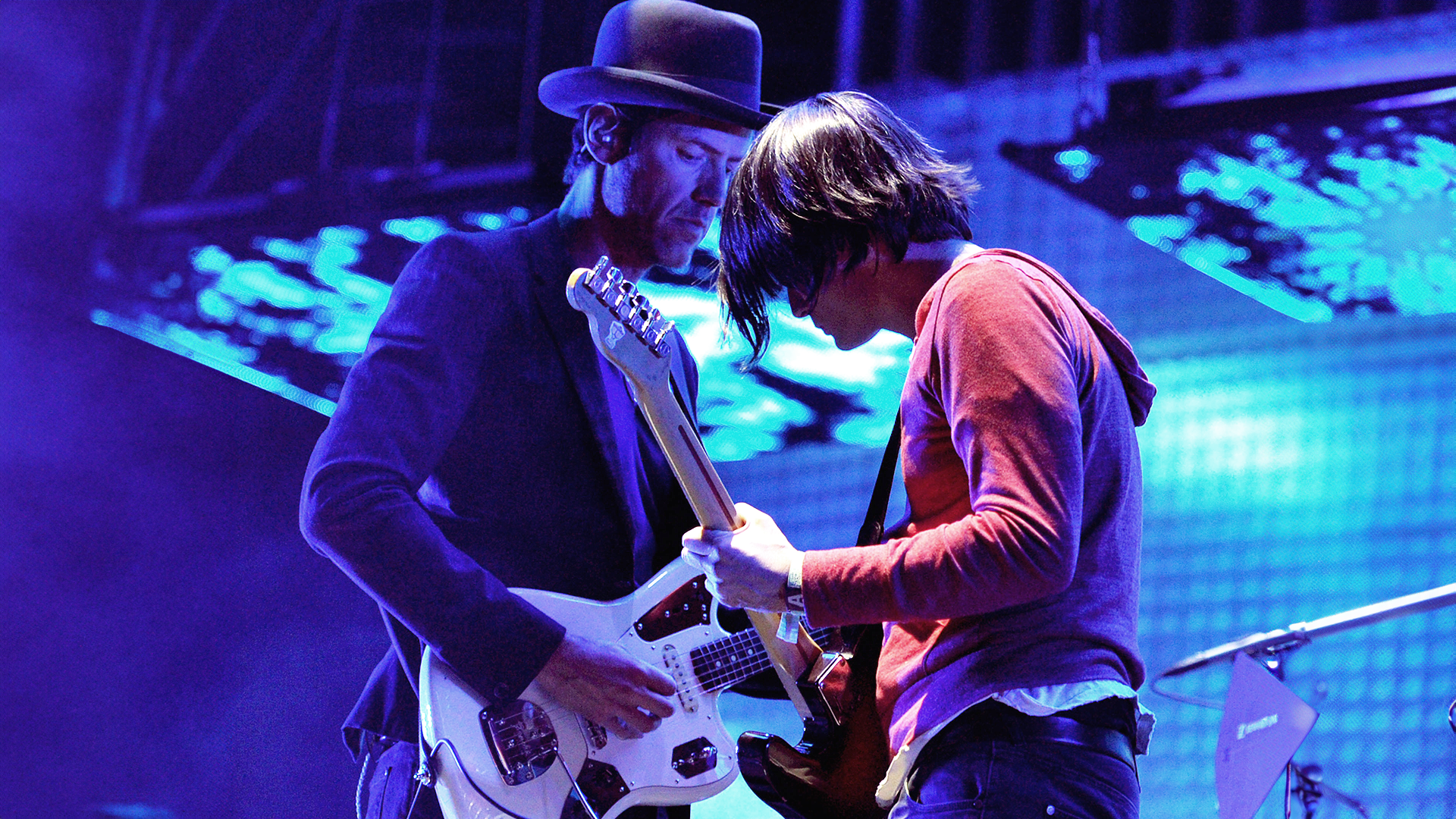
The strangest loneliness in music isn't playing badly—it's standing in a room full of genius and realizing your part hasn't been written yet. Ed O'Brien has spent thirty years navigating that particular ghost town, the space between Thom Yorke's haunting melodies and Jonny Greenwood's seismic riffs where the rhythm guitarist is supposed to simply disappear. What makes this particularly fascinating is how he transformed that erasure into an art form, proving that in a band as dissected as Radiohead, the most radical act might be knowing when not to pick up the guitar.
The Anxiety of the Empty Chair
Personally, I think there's a cruel irony in how the music industry celebrates the "three-piece" myth while ignoring the psychological toll of being the fourth pillar. When O'Brien tells us that early rehearsals felt like tap dancing—awkward, performative, searching for footholds on a floor already mapped by others—he's describing something far more universal than band dynamics. This raises a deeper question about creativity itself: can you develop an authentic voice when two other voices have already defined the architecture? I've watched countless musicians chase the "Radiohead sound" by mimicking Greenwood's effects or Yorke's falsetto, yet O'Brien's real lesson is that his power came from accepting limitation, from letting the song breathe around him rather than fighting for airtime. One thing that immediately stands out is how this mirrors the experience of every sideman who ever sat in a room wondering if they were necessary.
The Violence of Restraint
What many people don't realize is that Radiohead's live return has exposed how precarious their balance actually is. We fetishize the studio product—the crystalline production, the digital manipulation—but strip away the careful choreography and you're left with four humans trying not to collide. In my opinion, this reveals a mature understanding of orchestration that most guitar-driven bands never achieve; they want every member to shine, to solo, to prove their worth. O'Brien seems to understand something darker and more beautiful: that a note held back is often more devastating than one slammed forward. From my perspective, this is the difference between playing guitar and making music—the former is about presence, the latter is about absence.
The Alchemy of Live Mistakes
A detail that I find especially interesting is how he frames the OK Computer sessions as a moment when limitation became liberation. He mentions recording "Climbing Up The Walls" and "Let Down" live in the room, capturing magic through sheer proximity rather than technical perfection. What this really suggests is that the band's greatest work emerged not from meticulous planning but from the terror of collective vulnerability—those moments where you think "F**k! We made that" are usually the ones that outlive the carefully constructed tracks. If you take a step back and think about it, this speaks to a nostalgia for analog accident that we've lost in the age of quantization and Pro Tools. I find it especially interesting that he implies this was the last time they captured that lightning, suggesting that success itself may have poisoned their ability to stumble upon greatness.
The Philosophy of Shadows
Andy Summers' name drops here aren't mere guitar trivia; they're philosophical anchors. O'Brien is telling us that his heroes knew when to vanish, that space isn't emptiness but negative space—the silence that gives meaning to the noise. The Fender EOB Stratocaster represents perhaps the ultimate paradox: a signature model built by a guitarist who spent his career avoiding signature moves. Personally, I think that's the mark of true artistic integrity—he didn't need a gimmick to define himself because his restraint had already become his fingerprint. When he describes changing sounds three times in a song, it's not about gear fetishism but about disappearing and reappearing like a ghost at a banquet.
The Courage of the Void
Looking at Radiohead's trajectory, what stands out isn't their experimentation but their willingness to make each other uncomfortable. The "rubbish" rehearsal moments—the ones where everyone plays through and it sounds terrible—are the necessary compost for growth. In my opinion, most bands avoid this ugliness by over-rehearsing, by polishing before they've allowed the raw mess to exist. O'Brien's reflection suggests that Radiohead's longevity comes from tolerating the void, from sitting in the "where do I fit" anxiety until it transforms into something new. What this really implies is that creativity isn't about filling space but about having the courage to leave it empty and trust that something will grow there.
So what do we take away from twenty years of O'Brien's quiet revolution? Perhaps that the most profound contributions are often the ones nobody notices until they're gone. He's not the guitarist who solos; he's the guitarist who knows the solo isn't needed. In a world screaming for attention, his career is a masterclass in the power of restraint, a reminder that sometimes the most important voice in the room is the one choosing not to speak. Personally, I think we need more of that kind of silence—more artists willing to be the shadow, the accompaniment, the space between the notes where the real music lives.